The Global Rise of Digital Arrest: A Socio-Legal Analysis of India’s Cyber-Extortion Crisis
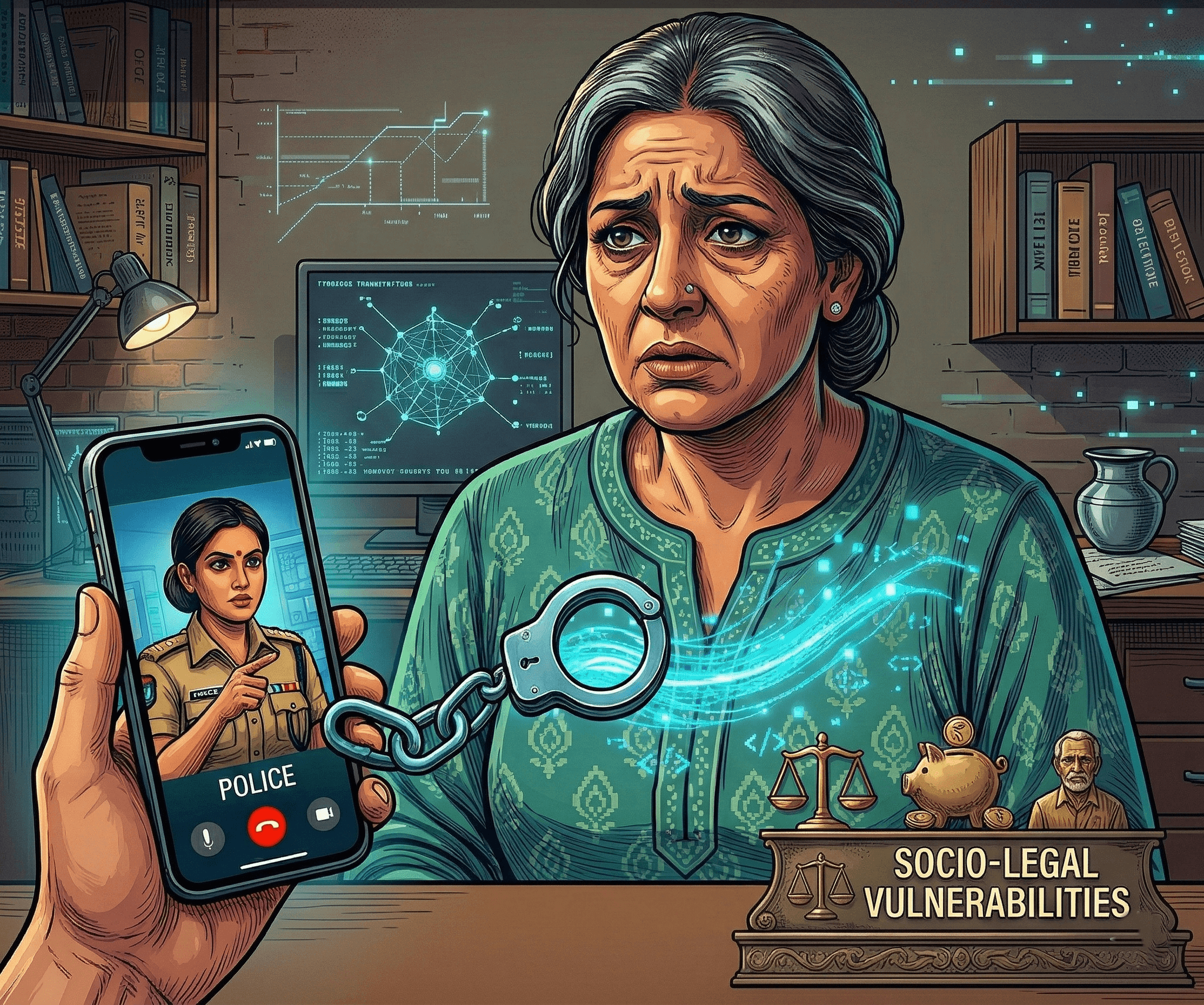
Imagine receiving a video call from a uniformed officer sitting in what looks like a legitimate police station. They claim a parcel in your name has been intercepted containing illegal narcotics or that your Aadhaar is linked to a multi-crore money laundering scheme. You are told you are under "digital arrest", forbidden from hanging up, contacting your family, or leaving your camera's sight.
This isn't a scene from a thriller; it is a meticulously engineered psychological operation currently draining billions from bank accounts across India. By early 2026, the cumulative financial impact of these scams reached staggering proportions, with the Supreme Court of India characterizing the situation as a "very big challenge" with a "grave human angle".
The Fraudulent Construct: Why "Digital Arrest" is a Myth
To protect yourself, the first thing to understand is that "digital arrest" is an entirely fraudulent construct. There is no provision in the Bharatiya Nyaya Sanhita (BNS), the Bharatiya Nagarik Suraksha Sanhita (BNSS), or the Information Technology Act for an arrest to be conducted virtually via video call.
In reality, a lawful arrest in India requires strict physical procedures: the presence of an officer, a written warrant, and the immediate production of the individual before a magistrate. Scammers exploit the public’s "fear of the police" and digital literacy gaps to create an illusion of legality that mimics official investigations.
By the Numbers: An Escalating Crisis
The scale of this cyber-enabled extortion is reflected in the reporting data from the Indian Cyber Crime Coordination Centre (I4C). Financial losses to cybercrime have skyrocketed as India's digital economy has expanded.
| Fiscal Year | Total Financial Loss (₹ Crore) | Total Incidents Reported |
|---|---|---|
| 2020 | 8.56 | Negligible |
| 2021 | 551.65 | 4,52,000 |
| 2022 | 2,290.23 | 10,29,026 |
| 2023 | 7,465.18 | 24,42,978 |
| 2024 | 22,845.73 | 36,37,288 |
| 2025 (Projected) | 19,812.96 (Jan-Oct) | 21.7 Lakh (Cheating only) |
While investment scams dominate the landscape, "digital arrest" has emerged as a high-value category, accounting for approximately 8% of total financial losses in the cheating category by 2025. In the first quarter of 2024 alone, Indians lost ₹120.3 crore to this specific modality.
Anatomy of a Scam: The Psychological Hijacking
A digital arrest scam is not just a technical breach; it is a form of "behavioral hijacking". It typically follows a chillingly consistent script:
- The Lure of Fear: It starts with a call from a spoofed number, often impersonating authorities like TRAI, the Mumbai Police, or courier services like FedEx. They claim you are implicated in drug trafficking or terror financing.
- Visual Deception: The victim is moved to a video call (Skype or WhatsApp). Scammers use AI-generated backgrounds of police stations and wear authentic-looking uniforms to build credibility.
- Virtual Captivity: The "digital arrest" begins. Victims are ordered to keep their camera on 24/7 and are isolated from their family under the threat of immediate "physical arrest" and social disgrace.
- Financial Extraction: Victims are coerced into transferring their savings into "government-monitored escrow accounts" for verification, with the false promise that the money will be returned once they are "cleared".
Landmark Cases: The Human Cost
The sophistication of these scams is best illustrated by the high-profile individuals they have targeted:
- The Vardhman Group Case: Industrialist S.P. Oswal was defrauded of ₹7 crore after scammers posing as CBI officials held him under "digital arrest" for two days, even sending a fake Supreme Court warrant via WhatsApp.
- The Naresh Malhotra Case: In one of the largest individual frauds in Indian history, an 82-year-old was coerced into transferring ₹22.92 crore. The case is currently before the Supreme Court, highlighting massive lapses in banking oversight.
- The Bhopal Retiree: A 71-year-old retired BHEL supervisor was held in "digital confinement" for an unprecedented 70 days, eventually transferring ₹68.3 lakh as his decision-making faculties collapsed under psychological pressure.
Knowing the Difference: Real Procedure vs. Scammer Tactics
| Feature | Legitimate Police Procedure | Scammer’s Tactics (Red Flags) |
|---|---|---|
| Initial Contact | Physical service of a summons or notice. | Unsolicited call via WhatsApp or Skype. |
| Interrogation | Conducted in person at a police station. | Conducted over video call while isolated. |
| Money Requests | No legitimate agency asks for money over the phone. | Demands instant UPI/Bank transfer for "verification". |
| Authority | Officers have verifiable IDs and station contacts. | Impersonation of judges or high-ranking federal officials. |
Remedial Framework: What to Do If Targeted
If you find yourself on a suspicious call, follow these expert-recommended steps:
- Stop and Think: Immediately disconnect. No real agency will arrest you for hanging up a video call. Real law enforcement agencies will never conduct investigations or make arrests via video call on platforms like WhatsApp or Skype.
- Do Not Pay: Never transfer money for "verification," "digital bail," or "security deposits," as these are common extortion tactics.
- Cease Communication: Do not attempt to "prove your innocence" or argue with scammers, as they are trained to exploit psychological fear and urgency.
- Call 1930: This is the national cybercrime helpline. Reporting within the "Golden Hour" significantly increases the chances of freezing the funds before they are siphoned off.
- Use the National Cyber Crime Reporting Portal (NCRP): File a formal complaint at cybercrime.gov.in to create a legal trail for investigation and recovery.
- Notify Your Bank: Request a dispute or chargeback and ask them to flag the recipient's account.
- Preserve Evidence: Take screenshots of call logs, WhatsApp chats, and transaction details. Do not delete the chat history.
- Secure Your Device: If you were forced to install any remote access apps, put your phone in airplane mode and perform a factory reset.
The Road Ahead: Institutional Defense
The Indian government is moving from awareness to structural reform. Key initiatives include:
- The "Kill Switch": A proposed mechanism to allow the instant freezing of bank accounts and digital wallets upon suspicion of fraud.
- CBI Pan-India Probe: The Supreme Court has empowered the CBI to lead a unified investigation into these scams, overriding state barriers.
- Banker Accountability: Authorities are investigating the role of "mule accounts" and may hold banks liable if they show negligence in detecting high-value suspicious transfers.
Conclusion: Strengthening the "Human Firewall"
Technical blocks on SIM cards and IMEIs are essential, but the ultimate defense is an informed citizen. By adopting the "Stop, Think, Act" mantra, we can ensure that progress in our digital economy is not undermined by the parallel economy of cyber deception.
Sources
- Supreme Court Steps in After Senior Citizen Loses ₹22.92 Crore in Digital Arrest Scam, Seeks Preventive Guidelines - CourtKutchehry
- Citizens lost over Rs 22,845 crore to cyber criminals in 2024: Govt - The Economic Times
- Digital arrest scam - Wikipedia
- steps taken to address the issue of digital arrest scams - PIB
- Digital Arrest Scam in India: Complaint & Money Recovery - Legals365
- 'Digital arrests' are a very big challenge; victims, mostly elderly, lost ₹3,000 crore in India alone, says Supreme Court - The Hindu
- 'Digital arrest' - Police won't arrest you on video calls: I4C advisory - The Federal
- digital arrest scam - PIB
- Digital Arrest Scam Defense: 7 Essential Legal Protections - The Kanoon Advisors
- Unmasking digital arrest: An emerging threat to modern society - Law Journals
- 'Cybercrime-as-a-Service' racket busted, two held from Madhya Pradesh - The Times of India
- India's digital arrest scams - Lowy Institute
- Fight Against Cybercrime Is a Collective Responsibility - MP Info
Related Posts
Web Scraping, AI Training, and India’s Data Protection Blind Spot
An analysis of how India’s Digital Personal Data Protection Act (DPDPA) treats publicly available personal data and why the law may unintentionally allow large-scale web scraping for AI training without meaningful consent or accountability.